
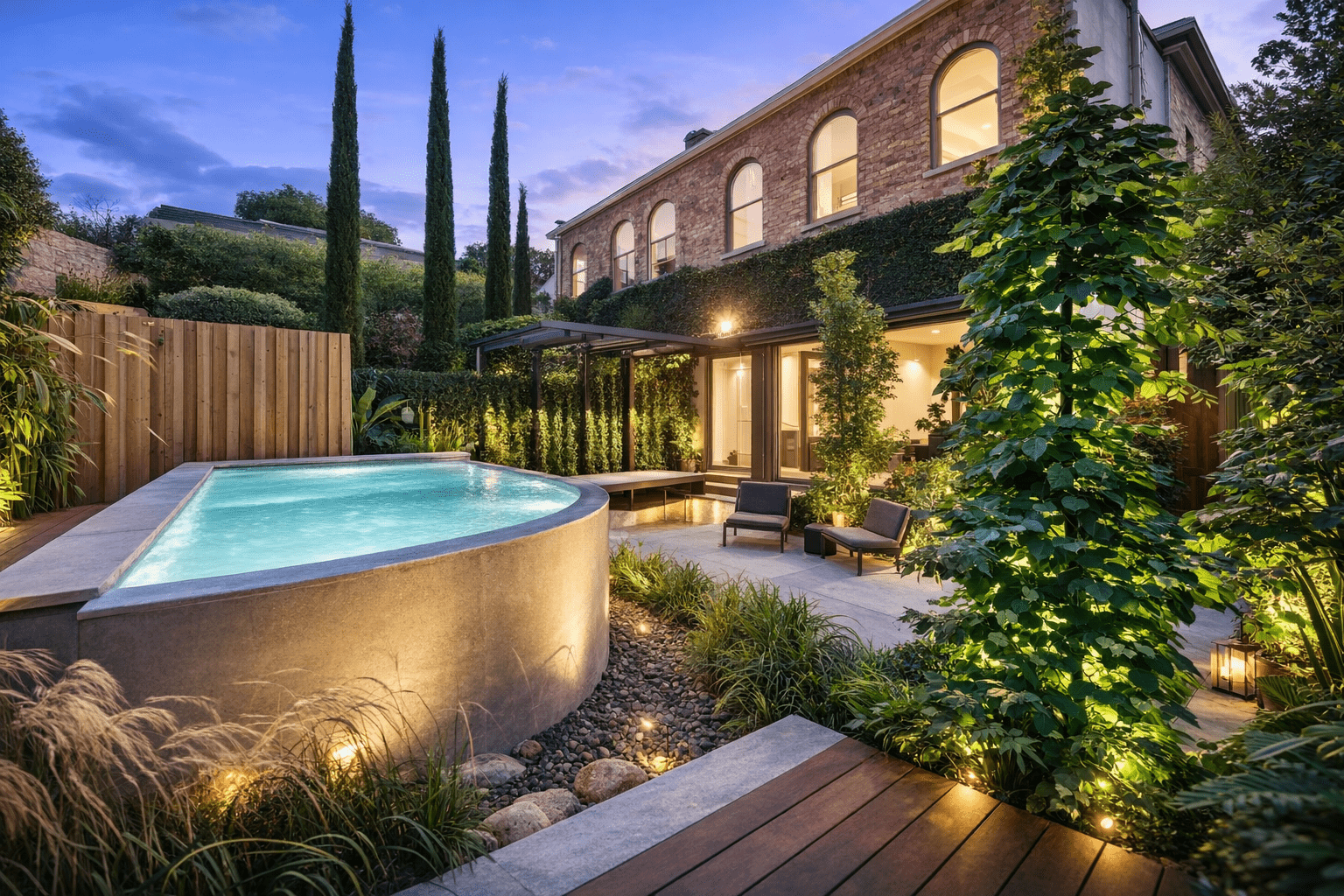
SMART DRAINAGE. LASTING PROTECTION.
Effective drainage solutions designed to manage water flow, prevent waterlogging and protect your landscape for years to come.
Water is essential to a healthy landscape – but in the wrong place, or in excessive amounts, it can quickly become a problem.
Phillip Merrett Landscapes considers drainage an important part of landscape design and construction. A well-planned drainage system helps manage how water moves through a property, reducing unwanted pooling, waterlogged areas, erosion and excess moisture around lawns, garden beds and constructed landscape features.
Landscape Drainage Designed for the Site
Every property manages water differently.
The slope and levels of the land, soil type, existing drainage, buildings, retaining walls, paving, lawns and garden beds can all influence where water travels and where problems may occur.
Rather than applying the same solution to every property, landscape drainage should respond to the conditions of the individual site.
Phillip Merrett Landscapes considers water movement alongside the broader landscape, allowing drainage to be incorporated into the design rather than treated as an afterthought.
Managing Water Pooling & Waterlogged Areas
Water that continually pools after rain can make lawns and garden areas difficult to use and may indicate that water isn’t draining effectively.
Likewise, garden beds that remain excessively wet can create unsuitable growing conditions for many plants.
Depending on the cause and site conditions, improving drainage may involve addressing ground levels, falls, surface water movement, soil conditions or installing appropriate landscape drainage systems.
The first step is understanding why the water is accumulating rather than simply moving the problem somewhere else.
Drainage for Lawns & Garden Beds
Healthy lawns and gardens require the right balance of water and drainage.
Poorly drained soil can remain saturated after rainfall or irrigation, while inappropriate ground levels can direct water towards areas where it isn’t wanted.
Drainage should therefore be considered alongside soil preparation, planting, lawn installation and irrigation.
This is particularly important when constructing a new landscape, as the opportunity exists to establish appropriate levels and drainage before lawns and garden beds are completed.
Drainage Around Paving & Hard Landscaping
Paving, pathways, retaining walls and other hard landscape surfaces can change the way water moves across a property.
Unlike planted areas, hard surfaces do not absorb water in the same way, making appropriate levels and falls particularly important.
Drainage planning should consider where water will travel from these surfaces and how it can be managed without creating unwanted pooling or erosion elsewhere in the landscape.
Drainage & Retaining Walls
Retaining walls and changes in ground level can have a significant influence on water movement.
Water accumulating behind or around retaining structures needs to be considered during the design and construction process. Appropriate drainage can help manage moisture and reduce unnecessary water pressure.
This is why drainage, excavation, levels and retaining wall construction should be considered together rather than as separate elements of a landscape project.
Preventing Erosion
Uncontrolled surface water can gradually remove soil, mulch and other landscape materials, particularly on sloping properties or where water becomes concentrated in one location.
Thoughtful grading, appropriate levels and drainage can help manage the direction and movement of water through the landscape and reduce erosion in vulnerable areas.
Drainage for New Landscape Construction
The ideal time to think about drainage is before the landscape is finished.
Planning drainage during excavation and construction allows levels, falls and drainage infrastructure to be considered before paving, lawns, garden beds and planting restrict access.
Phillip Merrett Landscapes can coordinate excavation, drainage, irrigation, paving, retaining walls, lawns and planting as part of the complete landscape construction process.
The result is an outdoor space designed not only for how it looks, but also for how it performs when the rain arrives.
Experiencing drainage problems or planning a new landscape? Contact Phillip Merrett Landscapes to discuss landscape drainage and complete landscape construction for your property.
FREQUENTLY ASKED QUESTIONS ABOUT steel edging
Steel garden edging is a narrow metal border used to create separation between different areas of a landscape. It is commonly installed between lawns, garden beds, pathways, gravel and other landscape surfaces.
Steel landscape edging helps define individual areas, maintain clean garden lines and provide separation between adjoining materials such as lawn, soil, mulch, gravel and paving.
Steel edging is strong, relatively discreet and versatile. It can provide crisp landscape lines without the visual bulk of some other edging materials and can be used to create both straight and curved borders.
Yes. This is one of its most common applications. Steel edging creates a defined boundary between the lawn and garden bed and can help prevent grass from spreading directly into planted areas.
Steel edging creates a physical separation that can help control lawn encroachment into garden beds. However, gardens still require ongoing maintenance and some grasses may spread by seed or other growth beyond the physical barrier.
Yes. Steel edging can define pathway boundaries and help separate pathway materials from surrounding lawns, garden beds or other landscaped areas.
Yes. Steel edging is particularly useful for separating gravel from lawns, garden beds and other surfaces and helping maintain a clearly defined edge.
Depending on the landscape design and construction requirements, steel edging can be used to create a defined transition between paved and planted or gravel areas.
Yes. One of the advantages of steel edging is its ability to form curves as well as straight lines. This makes it suitable for flowing garden beds, curved lawns and organic landscape designs.
Yes. Steel edging is particularly effective for creating crisp, straight lines in contemporary landscape designs.
Yes. Its slim profile and clean lines make steel edging particularly well suited to contemporary and minimalist landscapes, where definition is required without introducing a bulky border.
Yes. Steel edging doesn’t need to dominate the design. Its discreet profile means it can also be used to define more informal and naturalistic garden beds.
Steel is a strong material and is well suited to many landscape applications. Its longevity will depend on the type and finish of steel, installation, soil conditions, moisture and the environment in which it is used.
This depends on the type and finish of the steel. Some steel edging is specifically designed to develop a natural weathered or rusted appearance, while other products use protective finishes. The appropriate option depends on the desired appearance and landscape conditions.
Weathered steel edging is designed to develop an oxidised surface appearance over time. Its warm, earthy tones can work particularly well with stone, gravel, timber and planting.
Steel edging can be installed to create a relatively subtle border. Its narrow profile means the lawn, plants, paving or pathway generally remain the dominant visual elements rather than the edging itself.
Steel edging can help create separation between garden beds and adjoining surfaces and assist in keeping soil, mulch and other garden materials within defined areas.
Standard landscape edging is generally intended to define and separate surfaces rather than function as a substantial retaining structure. Where significant changes in level or soil retention are required, another landscape construction solution may be more appropriate.
The best material depends on the project, budget, appearance and required performance. Steel is often selected where strength, precise lines and a refined, long-lasting appearance are priorities.
They create very different finishes. Steel provides a slim and understated border, while concrete edging creates a more substantial visual and physical edge. The appropriate choice depends on the landscape design and function.
Steel edging is generally a relatively low-maintenance landscape element. Garden maintenance may still be required around the edge to manage grass, soil, mulch and surrounding planting.
Correct installation helps ensure the edging follows the intended line, curve, height and ground levels. Small inconsistencies can be particularly noticeable when steel edging is being used to create precise landscape lines.
Ideally, edging is considered as part of the landscape construction sequence. Installing it at the appropriate stage allows lawn, garden beds, soil and other materials to be finished neatly against the established border.
Yes. Steel edging works best when its position and shape are considered alongside lawns, planting, pathways, paving, gravel and other landscape elements.
Yes. Phillip Merrett Landscapes incorporates steel edging into landscape design and construction projects, creating defined transitions between lawns, garden beds, pathways and other landscape surfaces.
Contact Phillip Merrett Landscapes to discuss your landscaping project. Steel edging can be considered alongside the lawn, garden beds, planting, pathways and other elements of the proposed landscape.
.

LATEST NEWS
MaasSEO article for this page has not been added yet. Please add an article to see it here.